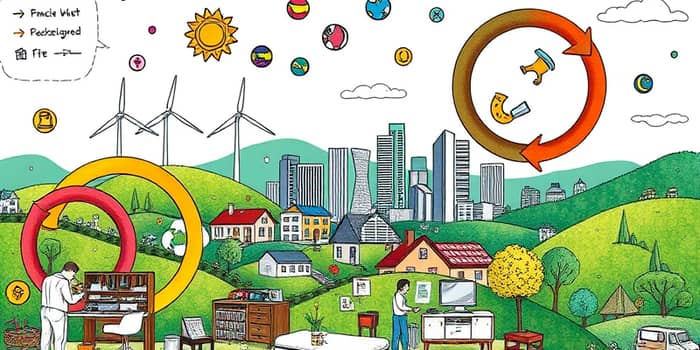
The global economy stands at a crossroads. As finite resources dwindle and environmental impacts mount, the circular economy emerges as a transformative model. By shifting from a traditional “take-make-dispose” approach to one that eliminates waste and pollution, circulates products and materials, and regenerates natural systems, stakeholders can unlock remarkable economic and ecological benefits. This article unpacks the current market landscape, highlights key sectors and business models, and offers practical guidance for investors and entrepreneurs looking to foster sustainable growth.
At its core, the circular economy is designed to create closed-loop systems where materials retain their value and harm to the environment is minimized. It stands in sharp contrast to the linear model, which relies heavily on resource extraction and disposal.
These three principles are supported by a spectrum of practices, from sustainable consumption to digital traceability and social well-being. Together, they form the foundation of a resilient, resource-efficient economy.
The circular economy market is experiencing explosive growth. In 2024, its global size is estimated between $638.57 billion and $656.23 billion. Looking ahead, forecasts project a rise to $2.2 trillion by 2034 (CAGR ~13.2%) or even $2.65 trillion by 2035 (CAGR ~13.57%).
Vibrant digital platforms and e-commerce channels are accelerating growth in resale, reuse, and remanufacturing. With cities achieving up to 80% waste diversion and potential for a 95% recycling rate, the market could soar to nearly $8 trillion by 2050.
Across industries, companies are pioneering circular solutions. Some leading sectors include:
Innovative business models are reshaping value chains:
Product-as-a-Service offerings replace ownership with leasing or subscriptions, ensuring products remain in use. Resale and Remanufacturing platforms extend lifespans by refurbishing items. Resource Recovery initiatives upcycle waste into new materials. And Extended Producer Responsibility schemes compel brands to manage products post-consumption, closing the loop.
Despite its promise, the circular economy faces challenges. High upfront investment, fragmented regulations, and limited consumer awareness can hinder progress. Technological constraints—especially around recycling certain plastics—remain significant.
However, powerful drivers are fueling momentum. Robust regulatory frameworks like the EU’s Green Deal, rising corporate ESG commitments, and growing consumer demand for ethical products are creating fertile ground for circular initiatives. Advances in AI, blockchain, and digital product passports are unlocking unprecedented supply chain transparency and efficiency.
For those seeking to harness this opportunity, action can start today:
By combining financial backing with hands-on involvement, stakeholders can help scale successful models and de-risk large-scale transitions.
The road to a global circular economy is paved with opportunity. Transitioning fully could unlock up to $3.4 trillion in economic benefits by 2030 and reduce greenhouse gas emissions by nearly 40% by 2032. Beyond numbers, it offers a chance to restore ecosystems, conserve biodiversity, and redefine prosperity.
Europe currently leads the charge, but Asia Pacific and North America are rapidly catching up. Untapped markets in developing regions offer fertile ground for innovation. As recycling rates climb and digital solutions mature, the ecosystem will expand, delivering both financial returns and environmental resilience.
Ultimately, the circular economy represents more than an investment thesis—it embodies a vision of sustainable progress. By aligning profit with purpose, investors and entrepreneurs can shape a future where growth regenerates, not depletes, our planet’s precious resources.
Embrace the circular revolution today and unlock the potential of a truly restorative economy.
References