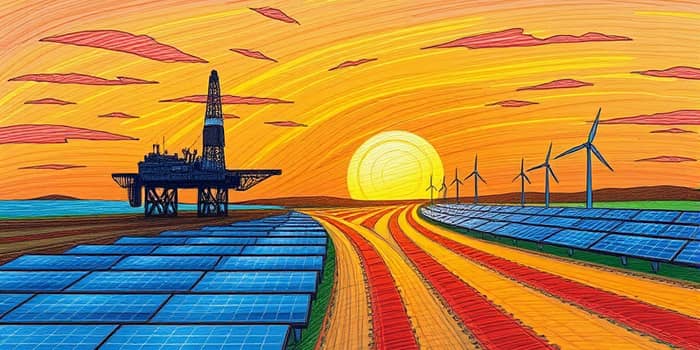
As global energy dynamics evolve, the moment of peak oil invites us to reimagine our collective future. We stand at the cusp of a profound shift—one that challenges long-held paradigms and opens doors to cleaner, more resilient power systems.
This article explores how historical production trends, current stagnation in fossil fuels, and the explosive rise of renewables converge to reshape economies, societies, and our planet’s climate trajectory.
For decades, analysts debated the concept of “peak oil,” the point at which global production can no longer keep pace with demand. Conventional crude output likely peaked around 2006 at 70 million barrels per day, according to the World Energy Outlook 2010.
Despite record U.S. production hitting 13.5 million barrels per day in both 2025 and 2026 as forecast by the EIA, overall global liquid fuel output has struggled to grow sustainably. In 2019, BP suggested we reached a plateau, driven by demand shocks, electric vehicle adoption, and declines in mature fields. The pandemic further accelerated demand destruction, underscoring the vulnerability of an energy model built on finite resources.
Although fossil fuels still supply over 55% of global electricity, growth has stalled. In the first nine months of 2025, fossil generation declined by 17 TWh, marking a managed decline of fossil power rather than abrupt collapse.
China, the engine of past fossil expansion, cut its generation by 52 TWh in the same period. In the United States, federal incentives and state mandates push utilities to retire coal and curtail gas plants. This decline aligns with carbon reduction goals and reflects a broader pivot toward low-carbon alternatives.
Renewables achieved a milestone in 2024 with over 510 GW of new capacity—an unprecedented leap. Another 520 GW is expected in 2025, pushing green sources to constitute more than 90% of all new power additions.
Rapidly falling technology costs for solar, wind, and storage have underpinned this surge, making renewables the cheapest source of new electricity in most markets. Solar now comprises nearly three-quarters of new installations, and global renewable capacity will top 5,800 GW by the end of 2025, up from 4,200 GW in 2023.
Different regions illustrate unique pathways through the transition. In the United States, renewable generation rose to 26% in 2024, propelled by a 40% surge in solar installations. Incentives at the federal and state levels aim to push this share above 40% by 2030.
China already boasts 1,400 GW of renewable capacity, half the global total, and continues to scale with a manufacturing base that drives down global equipment prices. India, the fastest-growing renewables market, added 17 GW of solar in 2024 and plans to nearly double capacity by 2030 through hybrid projects. The European Union achieved 70 GW of solar and wind additions in 2024, a 40% increase from 2022, with early 2025 additions up 60% year-on-year.
Despite strong momentum, challenges remain. Grid infrastructure must be modernized to handle variability and scale. Permitting delays for new projects slow deployment, especially in developing regions.
Financing constraints hinder markets in Africa, Southeast Asia, and Latin America, where capital costs and perceived risks remain high. Workforce reskilling is essential to shift labor from declining fossil sectors into expanding clean energy industries.
Transitioning energy systems create transformative economic opportunities through new industries, job growth, and local investment. The clean energy sector now supports millions of workers in manufacturing, installation, maintenance, and technology development.
Macroeconomic forecasts link energy transition policies to GDP growth; U.S. GDP is projected to grow 2.8% in 2025, in part due to renewable investments and efficiency gains. Globally, reducing reliance on imported fossil fuels enhances energy security and insulates economies from volatile commodity prices.
To align with net-zero targets, the world must sustain low-emission capacity additions of around 800 GW per year through 2030. Current trajectories hint at surpassing 1,000 GW annually if investment and policy momentum hold.
Ever-accelerating renewable expansion combined with energy efficiency, electrification of transport, and emerging technologies like green hydrogen form the backbone of decarbonization strategies. Continued collaboration between governments, industry, and civil society is crucial to address gaps in infrastructure, financing, and governance.
As we navigate the post-peak oil era, the choice before us is clear: cling to declining fossil pathways or embrace a diversified, resilient, low-carbon future. Every policy decision, investment, and community initiative can accelerate the transition or reinforce old dependencies.
By championing innovation, modernizing grids, and ensuring equitable access to clean energy, we can chart a new course—one where economic prosperity, social well-being, and environmental stewardship advance in harmony. The peak of petroleum is not an end, but the dawn of a more sustainable energy civilization.
References