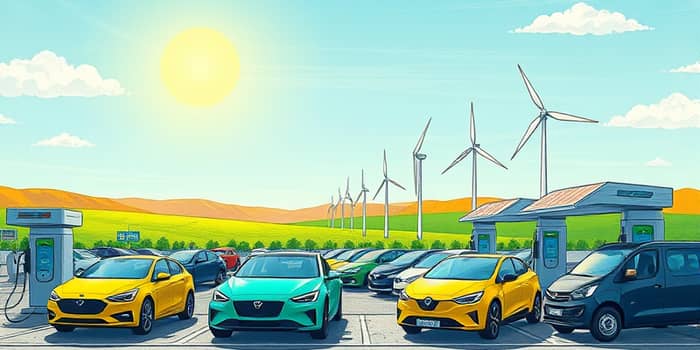
As the world races toward a low-carbon future, electric vehicles (EVs) have emerged as a linchpin of sustainable transport and a magnet for capital. Driven by technological advances, policy incentives, and growing consumer demand, the EV sector is witnessing unprecedented global growth and investment. This article explores the market dynamics, regional trends, industry strategies, and key challenges shaping this transformative journey.
Electric car sales are surging at an extraordinary pace. By the end of 2025, global EV sales are projected to top 20 million in 2025, representing one in every four new cars sold worldwide. In the first quarter of 2025 alone, over four million units rolled off assembly lines—a remarkable 35% year-on-year increase that underscores the sector’s momentum.
The total global EV fleet reached nearly 58 million vehicles by the close of 2024. According to industry forecasts, this fleet will approach 245 million by 2030 and could soar to 525 million by 2035, excluding two- and three-wheelers. These numbers reflect not only the accelerating pace of adoption but also the scale of investment required in manufacturing, supply chains, and charging infrastructure.
Regional patterns reveal both winners and emerging opportunities. China leads the charge, accounting for over two-thirds of global EV sales in early 2025 and more than 70% of EV production capacity. Europe and the United States follow, each with unique drivers and hurdles. Meanwhile, markets in Asia, Latin America, and Africa are experiencing explosive growth, signaling the next frontier of EV expansion.
At the heart of the EV revolution lies the battery. By the end of 2025, lithium-ion cell manufacturing capacity is expected to reach 3.8 TWh—double the projected demand. This expansion is fueled by large-scale investment projects, particularly in China, which produces 80% of global battery cells and sources over 85% of key materials.
In parallel, solid-state battery facilities are coming online, promising higher energy density, faster charging, and enhanced safety. Major automakers and startups alike are investing in pilot lines and scale-up projects, confident that next-generation batteries will further reduce costs and accelerate adoption.
As EV fleets grow, charging networks must keep pace. Public charging points worldwide doubled in two years to meet rising demand. Fast chargers (22–150 kW) now number two million units, while ultra-fast chargers (>150 kW) grew 50% to 71,000 stations by 2024. Yet, the IEA warns that public charging needs to grow ninefold by 2030 to support projected fleet sizes.
Vehicle-to-Grid (V2G) pilots in Australia, China, and the UK are exploring how parked EVs can stabilize electricity grids. These initiatives highlight the potential for EVs to provide grid services, creating new revenue streams and enhancing system resilience.
Policy remains a powerful catalyst. Early purchase subsidies played a crucial role in jump-starting demand, but mature markets are shifting support toward infrastructure, heavy-duty vehicles, and research. In Europe, stricter CO₂ emission standards and schemes like the UK’s Emissions Trading Scheme mandate a growing share of zero-emission registrations.
In the United States, the Inflation Reduction Act offers tax credits for EV buyers and charging infrastructure, although policy uncertainty at state levels introduces volatility. Emerging markets continue to deploy subsidies as a primary lever to boost adoption, balancing affordability with nascent charging networks.
Despite the optimism, the sector faces headwinds. Policy roll-backs or lapses in key markets can stall momentum, leading to short-term sales volatility. Consumer adoption in the mass-market segment remains uncertain as mainstream models compete on price, range, and design.
Infrastructure deployment lags in regions with rapid EV growth. Without adequate public and workplace charging, adoption may stall, particularly for drivers without home charging options. Supply chain bottlenecks, geopolitical tensions over critical minerals, and rising raw material costs add complexity to long-term planning.
Looking ahead, global EV share of new car sales could exceed 40% by 2030, with core markets surpassing 50%–60% share under current policies. The worldwide fleet is set to near 245 million vehicles in 2030 and half a billion by 2035. Achieving these milestones demands sustained capital inflows into battery manufacturing, charging infrastructure, grid integration, and recycling systems.
Industry leaders, policymakers, and investors must collaborate to bridge gaps, scale innovations, and unlock the full potential of electric mobility. By aligning strategies, sharing best practices, and maintaining a long-term vision, stakeholders can accelerate the transition to a cleaner, more resilient transport ecosystem that benefits society and the planet.
From burgeoning urban centers to remote rural roads, EVs are the vehicle of choice for a sustainable future. The time to invest is now. Together, we can drive forward the electric revolution and power the next era of global growth and environmental stewardship.
References