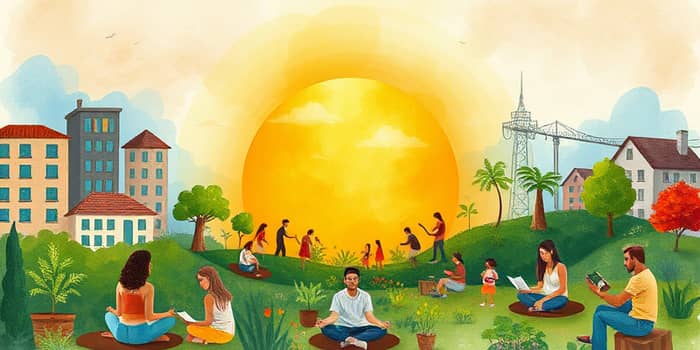
In a world driven by consumption and accumulation, the pursuit of material assets often overshadows the deeper dimensions of well-being. While money and possessions offer security, they alone cannot sustain lasting satisfaction. This article explores the profound benefits of cultivating non-material wealth and provides actionable pathways for nurturing your inner resources.
By shifting focus from external acquisitions to internal development, you can unlock untapped reserves of purpose, resilience, and joy. The insights that follow draw on research in positive psychology, behavioral economics, and real-world examples to guide you toward a more fulfilling life.
Material wealth is often measured in dollars, property, and tangible assets. It provides access to healthcare, education, and safety—essential foundations for any fulfilling existence. However, once basic needs are met, the additional boost to happiness from more possessions is limited.
In contrast, non-material wealth encompasses subjective, psychosocial returns: mental clarity, community bonds, and the freedom to choose how you spend your time. Concepts like time affluence and autonomy lie at the heart of this inner dimension, offering lasting satisfaction far beyond fleeting pleasures.
Empirical studies consistently show diminishing returns on happiness once income surpasses a threshold. In affluent societies, relative status and social comparison often matter more than absolute earnings. A high salary may shield you from financial shocks, but it cannot guarantee deep purpose or meaningful relationships.
Key findings include:
Inner richness arises from investments that compound over time. Unlike material goods, which offer brief pleasure, experiences and skills build enduring capacity. When you learn a craft, cultivate relationships, or carve out free time, you create resources that cannot be taxed or devalued.
Core elements of non-material wealth include:
Behavioral economics and positive psychology highlight the critical role of non-material investments in sustainable well-being. Urban planners advocate for walkable neighborhoods and civic spaces to foster community ties and reduce stress. Similarly, the Capability Approach argues for expanding real opportunities—health, education, participation—over mere financial growth.
Meta-analyses reveal that income–happiness correlations peak in unequal societies, where status and comparison drive much of our contentment. In contrast, community-driven cultures often report higher overall well-being despite lower average incomes.
Transitioning from material accumulation to inner growth requires intentional choices. Here are actionable steps to begin that journey:
Each of these actions nurtures inner resources that endure and grow. Over time, they form a protective cushion against stress and external upheavals, bolstering resilience and joy.
Investing in inner richness has far-reaching benefits: it promotes sustainable living, reduces dependence on consumerism, and fosters societal cohesion. Policy makers can support these aims by funding public spaces, subsidizing arts and education, and designing cities that prioritize people over cars.
For individuals, the journey toward inner wealth is both personal and communal. By embracing purpose-driven pursuits and nurturing relationships, we not only enrich our own lives but also contribute to a more compassionate society. Ultimately, the truest measure of success lies not in the possessions we hold, but in the depth of our connections, the clarity of our minds, and the freedom of our hearts.
As you reflect on your own path, consider this: the greatest legacy you can leave is the richness of your spirit, the strength of your community, and the fullness of a life well-lived.
References